Ryde to Pymble pipeline upgrade

Boosting water capacity for Sydney's North Shore

We’re bringing the Ryde to Pymble drinking water pipeline back into service by upgrading a vital connection to the Wahroonga Reservoir. The project will boost the water distribution system's capacity, ensuring we can meet the growing demand for drinking water and support continued housing growth across Sydney’s North Shore.


About this project

This original pipeline was built in 1936 and ran from the Sydney Water Ryde Pump Station along Victoria Road to Roland Avenue in Wahroonga. It served our customers well for over 70 years but was disconnected from the network in 2014 due to its age and condition.

We're now upgrading the water delivery system’s servicing capacity and increasing resilience of the Ryde system to help cater for increased growth across the North Shore.

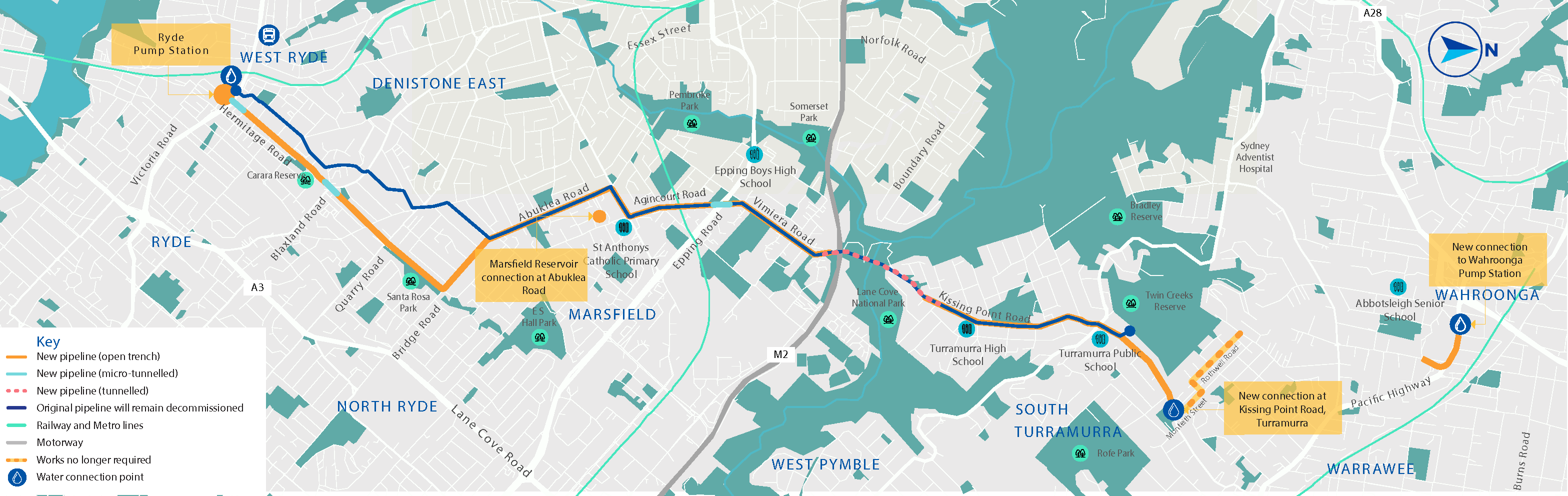
This will be done by reinstating the drinking water pipeline between Ryde Pumping Station and the connection point at Roland Avenue, Wahroonga. The upgraded pipeline will generally follow the alignment of the old existing main and extend to the Wahroonga Reservoir.

The upgraded pipeline is designed for a 100-year service life, ensuring safe, clean, and reliable water well into the future.


Project timeline

Mid 2025: Investigations to confirm design
November 2025: Delivery Partner contract awarded
December 2025 to June 2026: Detailed Design
April 2026: Site establishment
June 2026: Construction starts
2028: Construction complete


Project updates

31 August 2026
The Review of Environmental Factors Addendum has been determined

The Review of Environmental Factors (REF) Addendum for the project has now been determined, enabling the project to proceed to the next stage of delivery.

More information is available in our latest project update.

Read more
17 July 2026
Frequently asked questions about the upcoming Review of Environmental Factors Addendum

We heard a lot of good questions during the community sessions for the proposed changes to the Review of Environmental Factors. We have provided responses in this factsheet (updated September 2026).

Read more
16 July 2026
Out of Hours service location work will commence on Thursday 23 July 2026.

We'd like to inform you that Out of Hours Work will commence on Thursday 23 July 2026.

The service location work will be carried out at the corner of Kissing Point Road and Comenarra Parkway.

Please review the community notification here.

Read more
10 July 2026
Thank you to everyone who attended our community information sessions on 6 and 7 July 2026

We appreciate everyone who took the time to meet with the project team, ask questions and share feedback on the proposed changes to the Review of Environmental Factors (REF).

Feedback closes at 5:00 pm on Sunday 19 July 2026.

To provide feedback or find out more, please email rydepymblepipeline@sydneywater.com.au.

Read more
09 July 2026
Service location work.

We'd like to inform you that service location work is schedule to start in your area from Monday 6 July 2026 in the following locations.

Kissing Point Rd between Koombalah Ave and Comenarra Parkway

Hermitage Rd, Brenson Lane, Bridge Rd, Abuklea, Angicourt, Dayman and Vimiera Rd.

Read more
24 June 2026
Start of Work for the Ryde to Pymble pipeline upgrade project

Over the next six weeks, our teams will be out along the route checking ground conditions and locating underground services to help safely design the Ryde to Pymble pipeline upgrade. We'll send a detailed update with exact timings, locations, and traffic changes before work begins in your neighborhood, but you can read the full community notification here for more information.

Read more
06 July 2026
REF Addendum Feedback period extended

We have heard the community and understand some residents would like more time to review the information share their views. To provide more opportunity to participate, we have extended the feedback period.

If you haven’t yet shared your feedback, please email it to rydepymblepipeline@sydneywater.com.au before 5:00 pm, Sunday 19 July 2026.

Read more
29 June 2026
Update on Environmental Review (REF Addendum)

An REF Addendum is being prepared for the Project. This notification provides updated project information.

Some key facts of the REF Addendum, can be found here.

We are also hosting two community information sessions.

  • Monday 6 July from 4pm to 6pm at Ryde Library
  • Tuesday 7 July from 4pm to 6pm at Turramurra Community Hall.
Read more
09 June 2026
Site compound establishment – 238 Vimiera Rd, Marsfield

Our team will begin site establishment at 238 Vimiera Rd, marking an exciting step forward in bringing this project to life. You may notice increased activity in the area as we set up essential facilities and prepare the site for upcoming construction stages.

From Wednesday 10 June, we will be transporting heavy vehicles, including an oversized excavator, between 6pm and 7am to minimise daytime disruption.

In addition to this, we will also be establishing site compounds at Santa Rosa Park and at Sydney Waters Ryde Pumping Station, supporting the broader delivery of works across the project footprint.


We are committed to carrying out all works safely, responsibly, and with consideration for our neighbours. 

Read more
29 May 2026
Site compound establishment – Kissing Point Rd (verge) and Vernon St

Our recent community notification covering the Kissing Point Rd and Vernon St site compound included details that are yet to be confirmed. We’re continuing to work with Ku‑ring‑gai Council to confirm locations and timing for site compounds in the area. Once finalised, we’ll issue an updated notice with the correct information.


Read more
22 May 2026
Ryde to Pymble pipeline upgrade- Site location investigation work to start Friday 29 May 2026.

Essential service location works will take place from Friday 29 May 2026 to Friday 5 June 2026 across several areas, weather permitting. Please see the list of affected locations below.

Read more
30 April 2026
Ryde to Pymble pipeline upgrade compound sites notifications

A new compound notifications are now live on our project site. 

Read more
17 April 2026
Discover What’s Ahead for the Ryde to Pymble pipeline upgrade

We’re inviting the community to drop in, take a look at the project information on display, and chat with the RP03 team. Ask questions, share your thoughts, and learn more about the construction work starting soon.

Read more
16 March 2026
Epping Road and Daymon Place- Night Investigation Work

Night work is schedule to start on Monday 23 March until Tuesday 24 March 2026, weather permitting. Night work is shcedule to start at 8pm to 5am.

Read more
19 December 2025
Review of Environmental factors (REF) for the Ryde to Pymble pipeline upgrade is now published.

We’re getting in touch with an update on the Ryde to Pymble drinking water pipeline project.

Read more
19 December 2025
Ryde to Pymble pipeline upgrade- Start of Site investigation work

Investigation work is scheduled to start in January 2026 and will continue through to March 2026, weather permitting.

Read more
10 December 2025
Contract award

We are excited to announce that we have appointed the McConnell Dowell and Gamuda Joint Venture (MDGJV) to deliver the Ryde to Pymble drinking water pipeline. This partnership brings extensive experience in complex infrastructure projects and a collaborative approach to ensure sustainable outcomes for our community.

Read more
21 August 2025
Talk to the team - September 2025

We're holding drop-in sessions about the upcoming pipeline alignment and future construction. Please come along to learn more.    

Read more
05 February 2025
Nightwork investigations on Victoria Road and Hermitage Road

We are considering reinstating the Ryde to Pymble trunk main, a drinking water pipeline that runs from Ryde Pump Station on Victoria Road to the Wahroonga Reservoir site on Roland Avenue. As part of our planning and design work, we need to do some investigation work, which will involve potholing and road cutting.

Read more
01 January 2025
Nightwork investigations – January 2025

We're doing investigation work to improve access to drinking water in the area.

Read more
01 January 2025
Ground investigations – Abuklea Road and Anzac Avenue, January 2025

We're doing investigation work to improve access to drinking water in the area.

Read more
01 October 2024
Soil sampling on Roland Avenue and Ada Avenue

We are considering reinstating the Ryde to Pymble trunk main, a drinking water pipeline that runs from Ryde Pump Station on Victoria Road to the Wahroonga Reservoir site on Roland Avenue.

Read more

Ryde LGA

Project updates

26 October 2026
We'd like to inform you that Out of Hours Work will commence on Tuesday 27 October 2026.

The service location and potholing work will be carried along Brodge Road between Woorang Street and Donovan Street starting on Tuesday 27 October 2026.

Please review the community notification here.

Read more
12 October 2026
We're starting trenching work on Monday 19 October 2026 for the Ryde to Pymble Pipeline Upgrade Project: Vimiera Road near Dayman Place, Marsfield.

Starting Monday 19 October 2026, trenching work will start along Vimiera Road near Dayman Place, Marsfield. We appreciate your patience and cooperation. we recommend planning ahead for any minor travel delays in the area.

Please review the community notification here 

Read more
21 September 2026
We're continuing work for the Ryde to Pymble Pipeline Upgrade Project: Start of construction on Bridge Rd between Patricia St and Olive St.

From Monday 28 September 2026, construction and trenching work will take place along Santa Rosa Park easement between Quarry Road and Bridge Road, and along Bridge Road between Patricia Street and Herring Road.

Please review the community notification here. 

Read more
21 September 2026
We're continuing work for the Ryde to Pymble Pipeline Upgrade Project: Hermitage Road between Goodwin Street and Blaxland Road.

From Monday 28 September 2026, we’re continuing trenching work between Goodwin Street and Blaxland Road. We appreciate your patience and cooperation. we recommend planning ahead for any minor travel delays in the area.

Please review the community notification here.

Read more
04 September 2026
We're continuing work for the Ryde to Pymble Pipeline Upgrade Project: Agincourt Rd between Lancaster Dr and Culloden Rd.

From Friday 4 September 2026, we’re continuing trenching work along Agincourt Rd between Lancaster Dr and Culloden Rd. We appreciate your patience and cooperation. we recommend planning ahead for any minor travel delays in the area.

Please review the community notification here 

Read more
24 August 2026
Temporary water connection at Fay Place.

Work to install a water connection for the temporary compound site on Abuklea Road will start at Fay Place on Tuesday 8 September 2026.
For more information, read the community notification here.

Read more
17 August 2026
We're starting trenching work from Monday 24 August 2026 for the Ryde to Pymble Pipeline Upgrade Project: Agincourt Rd between Lancaster Dr and Culloden Rd.

Starting Monday 24 August 2026, trenching work will start along Agincourt Rd between Lancaster Dr and Culloden Rd. We appreciate your patience and cooperation. we recommend planning ahead for any minor travel delays in the area.

Please review the community notification here 

Read more
13 August 2026
We're temporarily relocating several bus stops

To keep everyone safe while we work on the Ryde to Pymble pipeline upgrade, we’re temporarily moving a few local bus stops.

We appreciate your patience and understanding, please check the details and find your temporary stop location in the community notification here.

Read more
12 August 2026
We're starting trenching work on Monday 17 August 2026 for the Ryde to Pymble Pipeline Upgrade Project: Hermitage Road between Wattle and Park Street.

Starting Monday 17 August 2026, trenching work will start along Hermitage Road between Wattle Street and Parkes Street. We appreciate your patience and cooperation. we recommend planning ahead for any minor travel delays in the area.

Please review the community notification here.

Read more
12 August 2026
We're temporarily relocating several bus stops

To keep everyone safe while we work on the Ryde to Pymble pipeline upgrade, we’re temporarily moving a few local bus stops.

We appreciate your patience and understanding, please check the details and find your temporary stop location in the community notification here.


Read more

Ku-ring-gai LGA

Project updates

12 October 2026
UPDATE – Important project update

We recently notified the community about planned construction work on Kissing Point Road between Saddington Street and Auluba Road.

Following further investigation on site, we have encountered unexpected ground conditions that require some changes to where and when we carry out our work.

Please click here to view the updated notification, which includes the revised construction schedule, work locations, and details of temporary road closures and detours that may affect your travel.

Read more
06 October 2026
We're starting trenching work from Monday 12 October 2026 for the Ryde to Pymble Pipeline Upgrade Project: Kissing Point Road between Saddington Street and Auluba Road, South Turramurra.

Starting Monday 12 October 2026, trenching work will start along Kissing Point Road between Saddington Street and Auluba Road, South Turramurra. We appreciate your patience and cooperation. we recommend planning ahead for any minor travel delays in the area.

Please review the community notification here.

Read more
01 October 2026
We'd like to inform you that Out of Hours Work will commence on Wednesday 7 October 2026.

The service location work will be carried on Kissing Point Road between Canoon Road and The Comenarra Parkway.

Please review the community notification here.

Read more
17 September 2026
Service location work starting Monday 21 September 2026 on Kissing Point Road between The Comenarra and Wattle Place.

We'd like to inform you that service location work will commence on Monday 21 September 2026.

The service location work will be carried on Kissing Point Road between The Comenarra Parkway and and Wattle Place.

Please review the community notification here.

Read more
17 September 2026
Compound locations confirmed in Ku-ring-gai

We can confirm the compound locations in Ku-ring-gai and would like to thank everyone who took the time to share feedback during the planning process.

Community feedback has played an important role in shaping our approach. We carefully considered the comments and concerns raised by local residents and, as a result, the previously proposed compounds on Yeramaba Street and at Kate Street/Tamboon Avenue will no longer be needed.

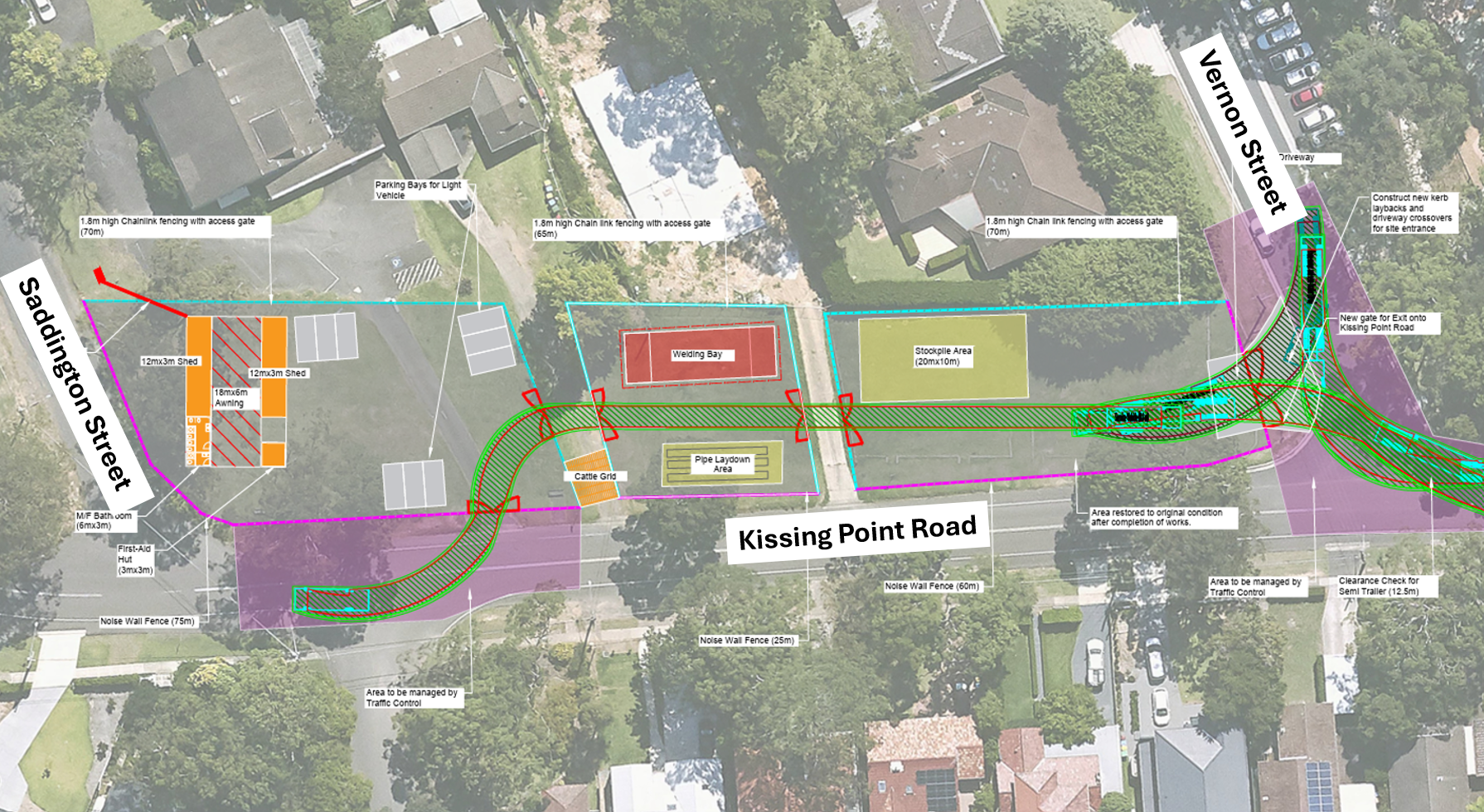
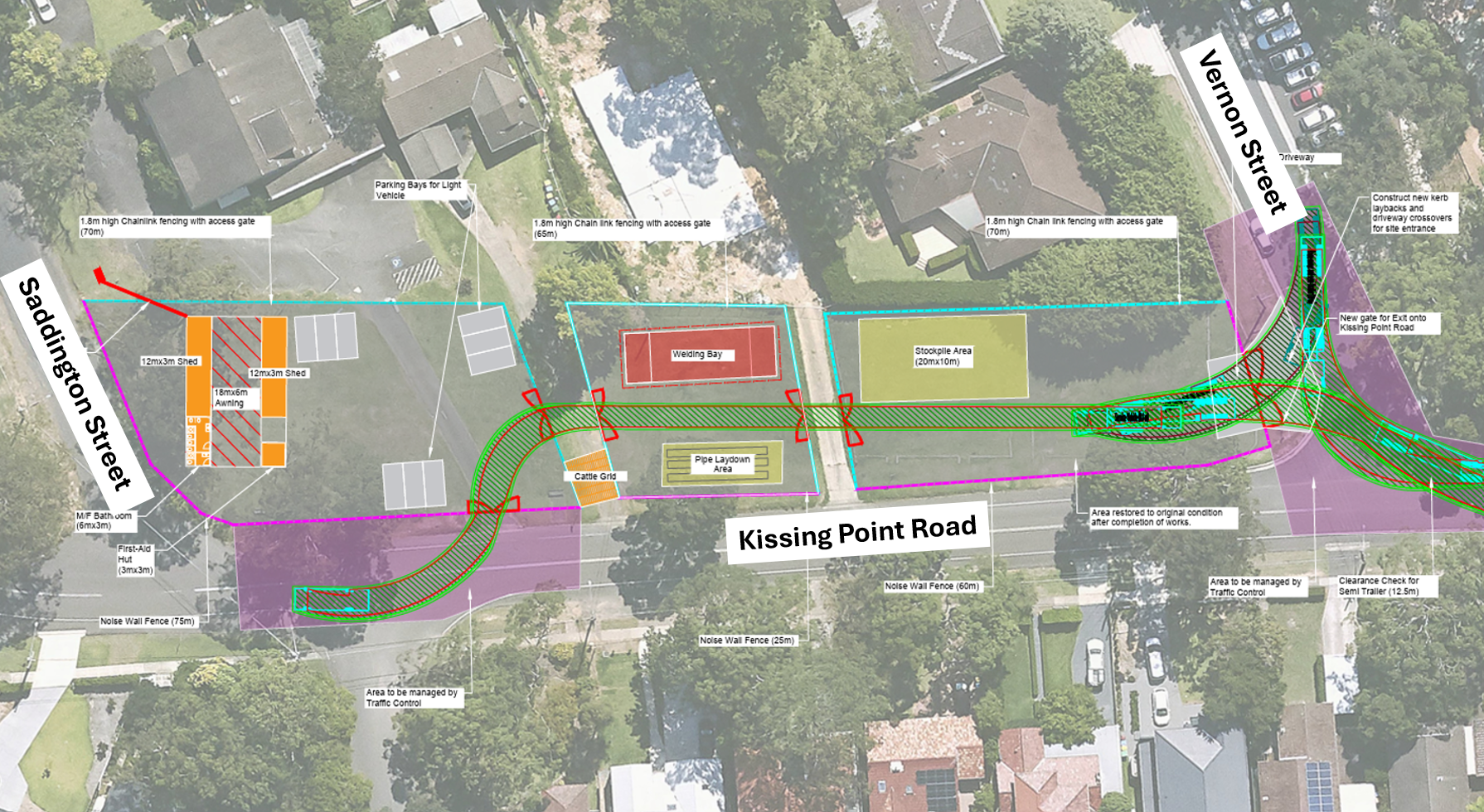
To support the delivery of the Ryde to Pymple pipeline upgrade project, the existing Kissing Point Road verge compound and Kissing Point Road receival shaft compound will remain in place.

You can view the compound on the maps below. The compound layout are subject to change.

Kissing Point Road Verge

Kissing Point Receival Compound

Read more
10 September 2026
We're starting temporary construction site set up and trenching work in the Ku-ring-gai area from Thursday 17 September 2026 for the Ryde to Pymble Pipeline Upgrade Project.

Starting Thursday 17 September 2026, we'll begin work in the Ku-ring-gai area. Early activities will include temporary construction site set-up, trenching works, tree pruning, and additional tree assessments. For more information, please review the community notification here.

We're also commencing trenching works on Kissing Point Road between Koombalah Avenue and Saddington Street. Traffic detours will be in place during these works, and motorists are encouraged to plan ahead for potential minor travel delays. Further details are available in the community notification here.

We thank the community for its patience and cooperation while these important works are carried out.

Read more
08 September 2026
We'd like to inform you that Out of Hours Work will commence on Monday 14 September 2026.

The service location work will be carried on Kissing Point Road between Canoon Rd and Wattle Pl.

Please review the community notification here.

Read more
04 September 2026
Out of hours oversize crane delivery on Monday 7 September 2026.

An oversized crane will be transported to our temporary site compound 250 Vimiera Road, Marsfield on Monday 7 September 2026 between 2am-7am.

The crane will be unloaded on site on Monday 7 September 2026 between 7am-12pm.

Please review the community notification here 

Read more
31 August 2026
Out of Hours service location work will commence on Monday 7 September 2026.

We'd like to inform you that Out of Hours Work will commence on Monday 7 September 2026.

The service location work will be carried on Kissing Point Road between Canoon Rd and Wattle Pl.

Please review the community notification here.

Read more
25 August 2026
Out of Hours service location work will commence on Monday 24 August 2026.

We'd like to inform you that Out of Hours Work will commence on Monday 24 August 2026.

The service location work will be carried on Kissing Point Road between Canoon Rd and Wattle Pl.

Please review the community notification here.

Read more
05 August 2026
Out of Hours service location work will commence on Monday 10 August 2026.

We'd like to inform you that Out of Hours Work will commence on Monday 10 August 2026.

The service location work will be carried along Kissing Point Road between The Comenarra and Wattle Place.

Please review the community notification here.

Read more


Frequently Asked Questions

Construction compounds are temporary work areas used during construction. They give workers a safe, organised place to:

  • store equipment and materials
  • park work vehicles
  • set up site sheds and amenities

Having compounds close to the work helps the project run safely and efficiently, with fewer vehicles travelling back and forth. 

Compounds are essential to build major infrastructure safely. They:

  • reduce truck movements on local roads
  • improve safety for workers and the community
  • help manage noise, dust and traffic more effectively.

Because land along the pipeline route is limited, only a small number of locations are suitable. 

Compound locations were selected in consultation with the City of Ryde Council and Ku-ring-gai Council through planning and coordination meetings that began in October 2025. Councils play a key role in reviewing and approving these sites. Locations were chosen based on:

  • safety
  • access for construction vehicles
  • environmental impacts
  • existing land use.

Other locations were considered but ruled out where they were unsafe, impractical, environmentally sensitive, or heavily used all year. 

Several temporary site compounds are proposed between Ryde and Pymble. These are on land owned or managed by Sydney Water, local councils, Transport for NSW and other private landowners. The table below shows the current proposed compound locations and their main purpose. Timing is indicative only and may change due to approvals, weather or construction conditions. Not all sites will be active at the same time.

Compound nameLocationLandownerMain useStartFinishExpected duration
Abuklea Rd – Transport Corridor103 Abuklea Rd, MarsfieldTransport for NSWLaydown, stockpiling, site sheds, pipe storage, welding23/4/20261/12/202720 months
Santa Rosa Park64 Bridge Rd, RydeCity of RydePipe storage, laydown6/6/20261/3/20279 months
Vimiera Rd – Waterloo Park North250 Vimiera Rd, MarsfieldCity of RydeLaydown, stockpiling, site sheds, pipe storage, welding28/4/20261/12/202720 months
Vimiera Rd – M2 Direct Pipe South283 & 109 Vimiera Rd, MarsfieldTransport for NSWDirect pipe launch, separation plant, sheds, crane, welding28/4/20261/12/202720 months
Kissing Point Rd – Retrieval342 Kissing Point RdKu‑ring‑gai CouncilMachinery, equipment, pipe storage1/6/20261/12/202718 months
Kissing Point Rd / Vernon St, TurramurraKissing Point Rd (verge)Ku‑ring‑gai CouncilMachinery, equipment, pipe storage13/5/20261/12/202718 months
Greater Parramatta and Olympic Peninsula (GPOP)13 Devon St, RosehillSydney WaterPipe storage, site shed1/6/20261/6/202714 months

Each compound will look slightly different, depending on its purpose. They may include:

  • temporary sheds
  • fenced storage areas
  • welding or pipe storage zones.

All compounds will be:

  • securely fenced
  • clearly signed
  • kept tidy and well managed.

Measures such as acoustic fencing, shade cloth and traffic controls may be used to reduce impacts. 

Construction activities will generally take place during approved standard working hours 7am-6pm from Monday to Fridays and 8am-1pm on Saturdays. No work will take place on Sundays or public holidays. For any work required outside of these standard hours, the community will be notified in advance.

Working hours at the Vimiera Road tunneling site will be 7am-6pm from Monday to Fridays and 8am-6pm on Saturdays.

We understand some people, including shift workers, are more sensitive to daytime noise. Where louder activities are planned near homes, advance notice will be provided and additional mitigation measures will be considered, where feasible.

We know environmental impacts are a major concern. The project will use approved management plans to control:

Noise

  • limit noisy work to standard hours
  • should we need to work outside of standard hours, we will notify the community in advance
  • position equipment away from homes
  • use quieter equipment and temporary acoustic fencing if needed.

Dust and air quality

  • water spray exposed areas when required
  • cover or manage stockpiles
  • clean roads if needed

Stormwater and sediment

  • install erosion and sediment controls before work starts
  • regularly inspect controls, especially after rain

Trees, parks and open space

We understand concerns about using parkland and reserve areas. Only the minimum area needed will be used and tree removal will be avoided wherever possible. Tree protection zones and fencing will be installed. After construction, all compound areas will be fully restored.

Restoring sites after construction

When a compound is no longer needed:

  • all temporary structures will be removed
  • land will be cleaned up and landscaped
  • turf, paths and vegetation will be reinstated.

Pre‑construction surveys will record existing conditions. After work is completed, Council and Sydney Water will check sites to make sure restoration meets agreed standards.

Traffic, trucks and safety

We know truck movements are a big concern. To manage this:

  • approved truck routes will be used
  • traffic controllers and signage will be in place
  • speed limits may be reduced near work areas.

Access to homes will be maintained wherever possible. If driveways are temporarily affected, residents will be contacted in advance.

Road conditions will be recorded before works start. Should any damage be caused by project vehicles, it will be repaired in consultation with Council.

Community access and amenity

Where compounds are in or near parks:

  • safe pedestrian access will be kept where possible
  • fencing and signage will guide people around work areas.

The aim is to maximise usable community space while keeping everyone safe.

Monitoring, compliance and accountability

The contractor and Sydney Water will:

  • regularly inspect sites
  • monitor environmental and traffic controls
  • respond to issues raised by the community.

Once sites are approved, the community will receive updates through:

  • project website
  • newsletters
  • local notifications or door knocks where needed.

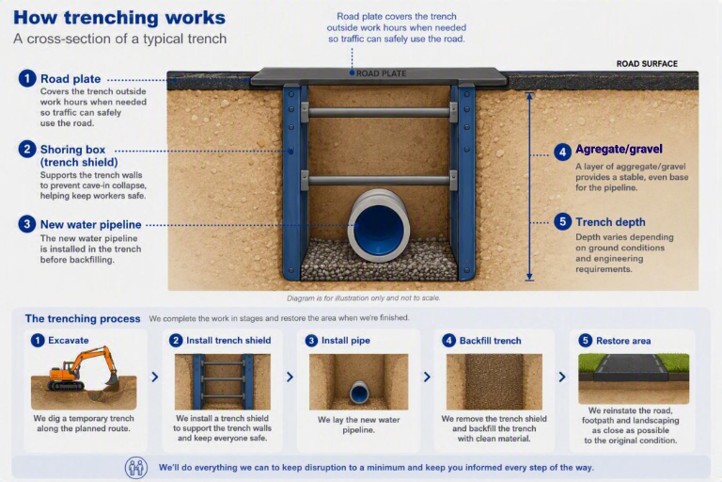
Trenching involves excavating a narrow channel in the ground to install underground infrastructure such as utility services, power, water or wastewater networks.

During the construction period, residents can expect daily activity involving construction vehicle traffic, localised construction noise, and temporary changes to normal access routes. Dedicated traffic control personnel will be on-site each day to manage vehicle movements, direct pedestrian flow, and safely guide residents through any temporary disruptions or detour points.

The depth of each trench depends on ground topography and location of existing services. We design all trenches to meet strict safety standards, engineering and operational requirements.

We're installing a new water pipeline to help provide a more reliable water network and support future growth. To install the pipeline safely, we need to dig temporary trenches along sections of the route.

We'll provide updates through notifications, signage, this project webpage and direct communication with affected residents and businesses when required.

Trenching work started on Monday 17 August 2026.

Our crew will aim to complete approximately 12 metres of trenching each day, subject to ground and site conditions.

We'll complete the work in stages and let you know before work begins near your property. Work directly outside or near your property are expected to take approximately two to three days.

As trenching progresses along the road, you may continue to experience varying levels of construction activity and noise as crews move closer to, and then further away from, your property.

Most trenching work will be done during standard work hours between 7am-6pm Monday to Friday and 8am-1pm on Saturday. Some trenching works will be scheduled to occur over weekends to limit impacts to road users.

In some locations, we may need to work at night to reduce traffic disruption and maintain access to roads. If this is required, we'll let nearby residents and businesses know in advance and explain what to expect.

Yes. The project team will work to maintain pedestrian and vehicle access wherever possible. If temporary restrictions are necessary, affected residents will be notified beforehand.

If work affects your driveway, we'll speak with you directly before construction reaches your property. We'll work with you to maintain access wherever possible and minimise disruption.

We'll work with your council and waste collection provider to make sure your bins are collected. If collection arrangements need to change temporarily, we'll let you know in advance.

Yes. Emergency services will continue to have access throughout construction, with traffic management arrangements in place where required.

We'll need temporary lane closures, road closures or changed traffic conditions while we do this work. Traffic controllers and signage will help keep everyone safe.

We understand parking is important for residents and businesses. Some on-street parking will be temporarily unavailable near active work areas. We'll keep these restrictions in place only while work is underway.

Trenching involves excavation equipment and construction vehicles, which can generate noise. Our team will keep work to approved working hours (7am-6pm Monday to Friday and 8am-1pm on Saturday) and implement measures to minimise impacts.

We'll use a range of measures to reduce dust, including watering work areas, covering loose materials and keeping the site tidy. These controls help minimise impacts on nearby residents, businesses and road users.

You may notice some vibration while work is underway. We’ll monitor levels and use practical measures to reduce impacts on nearby properties. If you’re worried about how the work may affect your property, please contact our team so we can talk through your concerns.

Safety is our top priority. We secure work areas with fencing, barriers, signage and traffic management measures. When trenches are open, we use trench shields (also known as shoring boxes) to prevent the trench walls from collapsing and to protect workers. Where required, trenches will be covered with steel road plates outside work hours so roads can be reopened safely.

No. Temporary fencing will be installed around active worksites to ensure trenches are secured, and residents are encouraged to keep children and pets away from construction areas.

If planned outages are necessary, affected customers will receive advance notice.

If a utility is accidentally hit, the project team will respond straight away and work with the utility provider to safely restore services as quickly as possible.

As each section of the new water pipeline is installed, the trench will be backfilled and any affected surfaces, including roads, footpaths and verges, will be temporarily restored. Permanent restoration will be completed in accordance with project requirements and relevant council standards prior to project completion.

We'll progressively restore affected lawns and landscaped areas as trenching work is completed. This may include replacing topsoil and re-establishing grass.

We understand trees and landscaping are important to the local community. We'll plan our work to minimise impacts wherever possible. If any vegetation needs to be removed or trimmed, this will only occur where necessary and in accordance with environmental approvals and project requirements.

We use a range of environmental controls throughout construction to minimise impacts on the local area. These may include dust suppression, noise management, erosion and sediment controls, waste management, spill response procedures and regular environmental inspections.

Feedback on the proposed changes was accepted between Monday, 29 June and Sunday, 19 July 2026. All feedback received during this period was considered as part of the assessment and finalisation of the REF Addendum. The community and stakeholders will continue to be engaged throughout the project. 

Community feedback has played an important role in informing project refinements. Through additional investigations and design development, Sydney Water has identified opportunities to further reduce impacts, including retaining 47 trees previously identified for removal, refining construction methods, reducing the footprint of the Kissing Point Road microtunnel retrieval compound, and reducing the number of temporary construction compounds in the Ku-ring-gai local government area from five to two. Further tree root mapping and tree-specific investigations will continue throughout construction to identify opportunities to retain additional trees. An alternative connection strategy has also removed approximately 900 metres of pipeline from the project scope, reducing community and vegetation impacts. 

The project team has investigated a range of alignment and construction options to minimise impacts on vegetation. The final pipeline route has been selected after considering existing utilities, environmental, engineering, safety, operational and property constraints. Where feasible, adjustments have been made to reduce impacts on trees and vegetation. 

Since the original REF was exhibited, additional design development, detailed surveys, utility investigations and arboricultural assessments have been undertaken. These investigations provided a more accurate understanding of the potential impacts of construction activities on nearby trees, including impacts on tree canopies and root systems.

As a result, additional trees have been identified as requiring pruning or removal, while other trees may be retained following further investigations such as root mapping. We are continuing

The REF process assessed the environmental impact of the proposed project based on the information available at the time.

During the early stages of project development, assessments are prepared using preliminary design information and assumptions.

As the design progressed, further investigations provided a better understanding of underground services, tree root systems, construction requirements and site constraints. This additional information triggered the review of the existing REF to ensure all potential environmental impacts are accurately identified and assessed.

The REF Addendum assessed the additional vegetation potentially impacted and outlines the measures to avoid, minimise or mitigate those impacts.

This ensures environmental assessments are based on the best available information and that any changes or new impacts identified during design development are transparently assessed. 

The approval pathway depends on the type of project and the outcomes of the environmental assessment. The Ryde to Pymble Pipeline upgrade was assessed through a Review of Environmental Factors (REF), which is the assessment process used for public infrastructure projects under Division 5.1 of the NSW Environmental Planning and Assessment Act 1979.

Through this process, Sydney Water examined potential environmental impacts of the project, including impacts on biodiversity, waterways, heritage, traffic, noise, vibration and the local community, and identify measures to avoid, minimise and manage those impacts. The REF also includes specific tests required under NSW legislation to assess whether impacts, including biodiversity impacts, are likely to be significant. The findings of those assessments inform the appropriate approval pathway for the project.

We have carefully reviewed our designs to protect as many trees as possible. While minor adjustments may still happen as work progresses, our priority is keeping environmental impacts to a minimum.

As construction gets underway, our project team and site arborists will continue doing assessment work to find every opportunity to minimize environmental impact.What if additional tree impacts are identified during construction?

Any changes to vegetation impacts will be managed in accordance with environmental approval requirements and project commitments. 

Tree root mapping is a specialised investigation used to identify the location and extent of a tree's root system. This information helps the project team understand whether construction activities can be adjusted to avoid significant roots and reduce impacts on individual trees. 

No. The maps identify trees that may be impacted by the project and include trees proposed for removal as well as trees that may require pruning.

Additional investigations, including root mapping and detailed construction planning will continue throughout the project. These investigations may allow some impacts to be reduced, and some trees currently identified as potentially impacted to be retained. 

Tree pruning is the selective removal of branches from a tree to manage its health, safety and appearance. Some trees along the construction corridor will need to be pruned to allow for safe construction access when installing the new pipeline, and to avoid hitting the tree and causing damage. 

Some trees need to be pruned to allow work to proceed and reduce the risk of a tree strike. Tree strikes can damage the trees, and create a safety risk for nearby workers and the community.

There are also trees that will be impacted by work, either to the Structural Root Zone (SRZ) or major encroachment into the tree canopy, which cannot be avoided. Because the work will likely impact their health and stability, these trees require removal. 

The Ryde to Pymble pipeline upgrade is critical to improve the reliability, capacity and resilience of Sydney Water’s network, for current and future communities across northern Sydney.

Although every effort is made to retain trees, some vegetation impacts cannot be avoided due to engineering, safety, access and operational requirements. Where impacts cannot be avoided, mitigation and offset measures will be applied. 

Each potentially impacted tree is assessed by qualified arborists. Considerations include the extent of impacts to the Structural Root Zone (SRZ), canopy encroachment, tree health and condition, species characteristics, safety considerations and the likelihood that the tree will remain healthy and structurally stable following construction. Where impacts can be avoided or reduced through design changes or modified construction methods, these will be adopted, rather than tree removal.  

Sydney Water has several independent checks and approvals in place to oversee vegetation impacts. Environmental assessments prepared by our delivery partner are independently reviewed by Sydney Water before decisions are made. Sydney Water has also engaged an independent Environmental Representative (who has been previously endorsed by DPHI), supported by a specialised independent arborist to review the Tree Impact Validation Procedure and monitor its implementation.

In addition, any proposed tree pruning or removal must be assessed through a formal process. A Tree Impact Permit is required before work can proceed, which Sydney Water must review and approve.

These measures help ensure that decisions about vegetation impacts are subject to independent review, appropriate environmental oversight and Sydney Water approval. 

All trees within and adjacent to the construction corridor will be assessed by qualified arborists. The assessment considers factors such as species, size, health, condition, life expectancy, habitat value and the potential impact of construction activities on each tree. 

The SRZ is the critical volume of soil directly surrounding the base of a tree that provides physical stability. Think of it as the tree’s foundation. It’s not just about where the roots go, but how they are arranged to keep the tree upright against gravity and wind.

A tree's root system and canopy often extend well beyond the visible trunk. Construction activities can affect trees through impacts to roots, branches, access requirements, construction equipment movements, temporary work areas and safety clearances.

For this reason, trees located several metres from the proposed alignment may still require assessment and may be potentially impacted. These trees are included in the assessment to ensure all construction-related impacts are considered and managed appropriately. 

All trees within the construction corridor have been assessed and documented but the project arborist. Only trees with potential direct impacts have been included to inform the REF Addendum.

Smaller shrubs and groundcover vegetation were assessed separately through the project's ecological and vegetation surveys. 

Options will be considered in accordance with project requirements and environmental commitments, with reuse or appropriate disposal where possible. This includes contacting local zoos (such as Taronga Zoo) to see if plant material can be used for food or habitat enrichment. 

If a tree is identified as providing important fauna habitat, it will be assessed by qualified environmental specialists. Prior to the removal of vegetation, a pre-clearance walkthrough will be completed by the project Ecologist. The project Ecologist will also be present during the removal of hollow bearing trees. 

Trees identified for retention will be protected through tree protection fencing, and clearly marked exclusion zone installation prior to the commencement of work. Our project team monitor construction activities to ensure these protection measures remain effective and that no unauthorised impacts occur within the exclusion zones. 

Yes. Direct impacts from vegetation clearing will be offset in accordance with Sydney Water’s Biodiversity Offset Guideline which is detailed in Table 5-4 of the REF. Depending on the type of impacted vegetation, this includes an offset multiplier of either 2:1 or 3:1.

For more Environmental protection information please visit our website www.sydneywater.com.au/environmental-protection 

The time required will depend on the species planted and growing conditions. While newly planted trees cannot immediately replace the canopy provided by mature trees, species will be selected to establish successfully and contribute to long-term canopy cover and biodiversity outcomes. 

We welcome community feedback on our replanting and are committed to incorporating community and Council feedback to determine the best locations and species for replanting. We’ll balance these community priorities with site specific conditions and environmental requirements to ensure the long-term health and suitability of new trees. 

Notifications are issued in advance of approved construction activities, including trenching work and tree pruning or removal. These notifications provide information on the timing of work, potential impacts and any associated traffic management arrangements.

The existing pipeline was constructed in 1936 and was decommissioned in 2014 due to its age and condition. The current project is to deliver a new pipeline to increase the capacity and reliability of the drinking water network and support growth across Sydney’s North Shore. A 900 mm pipeline has been selected to ensure current and future requirements are met. 

The upgraded pipeline follows the existing pipeline alignment between Abuklea Road and Turramurra Public School. In other sections, a new route is required to enable construction and minimise impacts.

On Kissing Point Road, the new pipeline will be installed in the northbound lane (travelling uphill). This alignment has been selected to avoid conflicts with underground services and the existing pipeline, which is located in the southbound lane.

A trenchless technique know as Tunnel Boring Machine (TBM) will be used to avoid disturbing this environmentally sensitive area. TBM is used to excavate tunnels safely while minimizing disruption to the above surface. Two shafts will be excavated to accommodate the launch and receival of the micro tunnel boring machine.

The launch shaft will be on the southern side of the M2 at the end of Vimiera Rd, Marsfield and the receival shaft is planned to be on Kissing Point Road, South Turramurra north of Lane Cove National Park.

Further investigations of the intended connection point at Roland Avenue and the existing 1200mm water main have confirmed that the condition of the main was significantly better than originally anticipated.

As the existing main runs parallel to our design, this presented an opportunity to relocate the connection to the intersection of Monteith Street and Kissing Point Road. Utilising the existing main from this location enabled us to descope about 1km of the proposed pipeline and reduce associated community and vegetation impacts. Some isolated work in this section is still required. 

Open trench construction will be used along Kissing Point Road. While tunnelling was considered, it is not practical along this urban corridor. Tunnelling requires large launch and retrieval shafts at either end of the tunnel, as well as substantial work areas for tunnelling equipment, pipe storage, spoil removal and the progressive feeding of pipe sections into the tunnel.

Finding multiple sites large enough to accommodate these activities is not possible in a built-up area such as Kissing Point Road, where space is limited and surrounded by roads, homes, businesses and other infrastructure.

Open trench construction is therefore the most suitable method for the majority of the alignment, as it can be delivered within the existing road corridor without the need for large tunnelling compounds at either end of a tunnel section.

Tunnelling will only be used where open trench construction is not practical, such as beneath the Lane Cove National Park and the M2 Motorway. At these locations, the pipeline needs to be installed at significant depth and pass beneath major infrastructure, the Lane Cover River, and other terrain features. Tunnelling allows these crossings to be completed safely without the extensive excavation that would be required for an open trench through a national park or across a major motorway corridor.

To install the pipeline, sections of the road will need to be excavated and temporarily closed while work is carried out. Typically, work will be undertaken in segments between intersections, with each section closed from Monday to Friday while construction is completed in that area.

Property access will be maintained wherever possible, subject to safety requirements and traffic management arrangements. Detours will be in place to help motorists travel around the work zone.

Keeping a road section closed while work is underway is more efficient than reopening and reclosing the road each day. This approach allows construction to be completed more quickly, reducing the overall duration of work and minimising the project's presence and disruption within the community. 

Yes, traffic management measures including temporary traffic control and clear signage will be implemented. This will include side streets to ensure the safe movement of vehicles and pedestrians during construction.

Traffic Guidance Schemes will be developed for each work area to maintain safety for motorists, pedestrians and workers. Measures may include temporary road/lane changes, traffic controllers, signage and staged work.

The community will receive notifications before significant traffic changes occur. 

Maintaining safe access for schools, shops, pedestrians and residents is a key priority throughout construction. Traffic management measures will be implemented to maintain access, with any temporary changes communicated in advance.

Where possible, construction activities near schools will occur during school holiday periods to minimise impacts on students, families and school operations. 

Standard work hours are 7am-6pm Monday to Friday, and 8am-1pm on Saturdays. Direct pipe drilling work, from the launch site at Vimiera Road to the retrieval at Kissing Point Road, will be during standard work hours during the week and extended on Saturdays to 6pm.

Occasionally, work may be required outside of standard work hours due to road restrictions, transport requirements, or permit conditions.

If work is needed outside standard hours, nearby residents will be notified in advance with details of the work.

Yes. As the project progresses, relevant project updates will continue to be provided through community notifications, the project webpage and stakeholder communications where appropriate. Information released will reflect project milestones, approved activities, construction planning and other matters relevant to the community. The project webpage will continue to provide access to relevant REF Addendum information and project updates as they become available. 


More information