


Log in
Upgrading wastewater infrastructure across Sydney
We're upgrading the Malabar system over the next few years to meet future demand. This work will make our water services more efficient and sustainable.
About this project
Sydney Water is investing in the Malabar System Investment Program to help support Sydney's growing population and ensure wastewater services remain reliable for the future.
The Malabar wastewater system serves more than one third of Sydney's population, collecting and treating wastewater from communities across western, southern and eastern Sydney. As these communities continue to grow, parts of the existing wastewater network need to be upgraded to meet future demand and help protect local waterways.
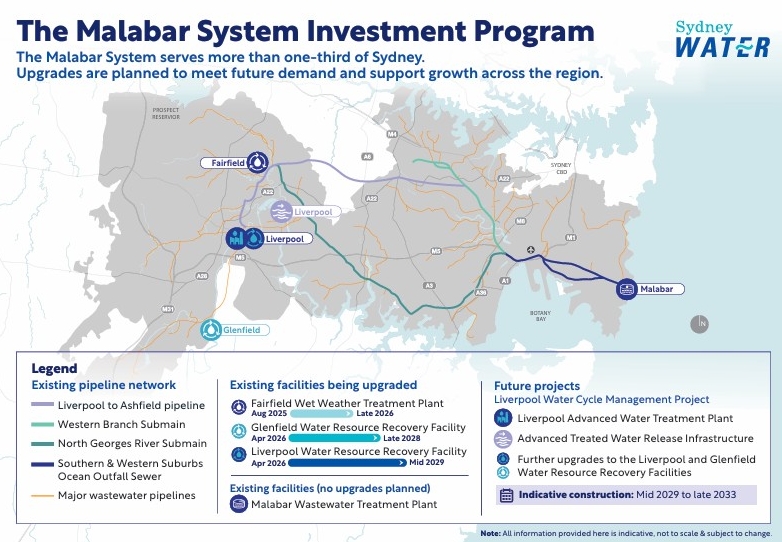
While the Malabar Water Resource Recovery Facility is located in Sydney's east, it is part of a broader wastewater network that services communities across a large part of Sydney. The program includes upgrades to treatment facilities, pipelines and other supporting infrastructure at a number of locations across the network.
Together, these projects will help ensure the wastewater system continues to support growing communities, protect the environment and provide reliable services for decades to come.
Where work is happening
Projects under the Malabar System Investment Program include:
- Upgrades at Fairfield Wet Weather Treatment Plant
- Upgrades at Liverpool Water Resource Recovery Facility, including construction of a new Advanced Water Treatment Plant
- Upgrades at Glenfield Water Resource Recovery Facility
- Investigations and planning for future infrastructure projects.
Network‑wide supporting works
As upgrades are delivered at treatment facilities, supporting works may also be undertaken across the network. These could include new or upgraded pipelines connecting facilities, odour control systems, and other infrastructure needed to support the overall network.
Liverpool Water Cycle Management Project
This project is currently in the early planning stages. Investigations and environmental assessments are underway to help inform a future Review of Environmental Factors, which is expected to be prepared in mid to late 2027.
The project is exploring options to safely treat wastewater using advanced treatment processes before releasing it to the Georges River. The aim is to support the long-term performance and resilience of the wastewater system while continuing to protect river health.
This project forms part of broader investment in Sydney's wastewater network to support a growing population and improve how wastewater is managed across Greater Sydney.
For more information about the Liverpool Water Cycle Management Project, see the fact sheet below.
Why these upgrades are important
Upgrading the Malabar wastewater system will help:
- increase wastewater treatment capacity to support housing and population growth
- improve reliability across the network to reduce breakdowns, overflows and pressure on ageing infrastructure
- reduce environmental impacts by improving the quality of treated water released to the environment
- reduce odour for surrounding communities through upgraded odour control systems at key network sites
- increase resilience to extreme rainfall and climate impacts ensuring the system can better manage wet weather flows
- improve operational efficiency by enabling better system monitoring, automation and real time management.
These improvements will help ensure Sydney’s wastewater system continues to safely support our growing communities.
What happens next
Projects across the Malabar System Investment Program are at different stages of planning, assessment and delivery.
As projects progress, Sydney Water will continue to keep communities informed about upcoming investigations, environmental assessments, construction activities and key project milestones.
Subscribe for updates to stay informed about project progress, upcoming activities and opportunities to learn more.
Project timeline
Project updates
Site investigations - Georges River
Sydney Water will be completing investigations along Georges River to support early planning for future growth and increased wastewater demand within the Liverpool LGA.
We’ll be undertaking low impact geotechnical investigations in Georges River near the Rabaul Road boat ramp, and in the reserve behind Riverside Road. This work will allow us to determine ground conditions along Georges River.

More information
Fairfield Wet Weather Treatment Plant
- Fairfield upcoming night work October 2026
- Fairfield North Street Update October 2026
- Ashfield flowmeter update September 2026
- Fairfield project update June 2026
- Fairfield upcoming night work May 2026
- Ashfield odour control unit update Fairfield project May 2026
- Ashfield odour control unit Fairfield project March 2026
Liverpool Water Resource Recovery Facility
- Liverpool community update October 2026
- Liverpool project newsletter September 2026
- Liverpool site establishment notification March 2026
Glenfield Water Resource Recovery Facility