


DSPs are the documents that explain what each infrastructure contribution is for and how it has been calculated. Sydney Water has revised the Rouse Hill Stormwater DSP to include updated charges for stormwater services.
Log in
Have your say between 1 December and 27 February
We've updated infrastructure contributions in the Rouse Hill stormwater development servicing plan (DSP). We invite all interested stakeholders to provide feedback during the public exhibition period from 1 December 2025 to 27 February 2026.
What's in the DSP
The Rouse Hill stormwater DSP sets out the infrastructure contributions that developers must pay within our Rouse Hill stormwater catchment. This catchment includes parts of Acacia Gardens, Beaumont Hills, Bella Vista, Box Hill, Castle Hill, Glenwood, Kellyville, Kellyville Ridge, Kings Langley, North Kellyville, Norwest, Parklea, Quakers Hill, Rouse Hill, Stanhope Gardens, Tallawong and The Ponds.
The infrastructure contribution for the Rouse Hill stormwater catchment covers land acquisition and associated costs, along with a range of stormwater management infrastructure. This infrastructure includes detention basins, wetlands, trunk drainage pipes and channels, gross pollutant traps, trash racks, and creek and wetland rehabilitation works.
How we've revised the DSP
We've updated the charges that developers must pay for stormwater management services. We've used the methodology that our regulator, the Independent Pricing and Regulatory Tribunal (IPART), set in its 2018 determination.
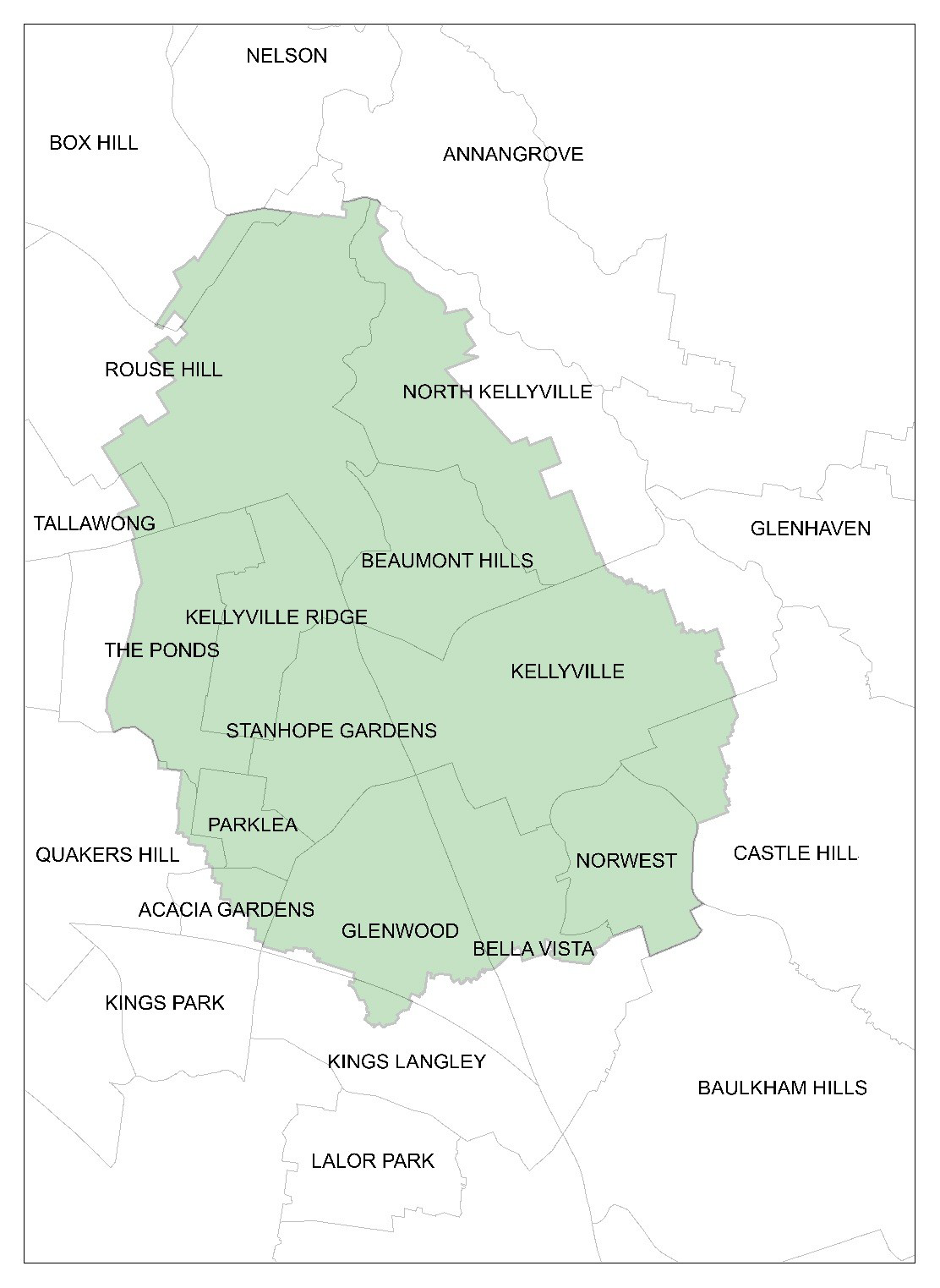
Our Rouse Hill stormwater catchment area
Have your say
Public exhibition period
Monday 1 December 2025 – Friday 27 February 2026
As an interested stakeholder, your feedback is valuable. Please have your say during our online public exhibition period. Feel free to ask questions, and send a written submission to let us know what you think of the revised DSP and the associated documents.
Email your written feedback directly to us at infrastructure.contributions@sydneywater.com.au between 1 December and 27 February.
How your feedback will be used
Your written submission won't be published. We'll consider all written submissions as part of the Rouse Hill stormwater development servicing plan that will be registered with IPART, and provide IPART with a copy of all submissions. All names and other identifying information will be removed. We may use information we gather in developing future documents to inform other government agencies and/or IPART. We'll publish a what-we-heard summary report on our website.
View exhibition documents
The Rouse Hill Stormwater DSP exhibition documents are available below. Please also refer to the supporting FAQs. Feel free to contact us with any questions or provide a submission at infrastructure.contributions@sydneywater.com.au.
Infrastructure contributions are payments towards the cost of delivering and managing infrastructure needed to provide water, wastewater or stormwater-related services to new developments. Most water utilities across Australia require developers to contribute to the costs that new developments place upon these systems. These are called infrastructure contributions.
The infrastructure contribution for the Rouse Hill Stormwater Scheme covers land acquisition and associated costs, along with a range of stormwater management infrastructure. This includes detention basins, wetlands, trunk drainage pipes and channels, gross pollutant traps, trash racks, and creek and wetland rehabilitation works.
Infrastructure contribution charges are only payable when a property owner (developer) decides to develop their property. The charges don't apply to property owners who are not developing their property.
As a condition of development consent, a developer must obtain a Section 73 Compliance Certificate from Sydney Water confirming that satisfactory arrangements for the provision of water-related services to a development have been made. In our Rouse Hill catchment, stormwater is one of the services we provide to development. Infrastructure contributions are payable for all developments that require a Section 73 Certificate. The Certificate confirms services are available, and the contributions must be paid by the proponent of the development before the Certificate can be issued.
Stormwater infrastructure contributions are one of the charges the NSW Government reintroduced under a phased-in approach from 1 July 2024. These charges cover the net cost to provide new services to development and ensure development is not subsidised by customer charges. However, in 2023 we did not update the Rouse Hill stormwater DSP because customers in this stormwater catchment were paying the Rouse Hill land charge set by IPART in 2020, and these charges couldn't be phased out until IPART reviewed those charges. It would have been inappropriate for Sydney Water to reintroduce a contribution paid by developers while we were still collecting a contribution for development services directly from new customers.
As part of its final determination of Sydney Water's 2025–30 prices, IPART ended the Rouse Hill land charge from 1 October 2025. This means new development in the catchment will no longer be funded by the customers in the catchment through that land charge. Instead, developments will need to contribute to the cost of this infrastructure directly. The updated DSP prices reflect the estimated cost of connecting new developments to the stormwater system to manage flooding and protect downstream waterways (like the Hawkesbury-Nepean River) from pollution and damage caused by stormwater runoff.
In this case, the costs are shared between both existing and future development. Existing development includes the growth that occurred since the early 1990s when the catchment was first rezoned. Future development is what we anticipate is yet to occur within Sydney Water's Rouse Hill stormwater catchment area. The costs are shared equally through IPART's infrastructure contribution methodology and resulting charges, and will only apply to new (future) development from 1 October 2025.
The information on this webpage is only applicable to development in Sydney Water's Rouse Hill stormwater catchment, which includes parts of Acacia Gardens, Beaumont Hills, Bella Vista, Box Hill, Castle Hill, Glenwood, Kellyville, Kellyville Ridge, Kings Langley, North Kellyville, Norwest, Parklea, Quakers Hill, Rouse Hill, Stanhope Gardens, Tallawong and The Ponds. The details of the precinct are set out in the DSP as well as the map on this webpage.
Note that the charges only apply to property owners (developers) who are developing their property.
Infrastructure contributions are payable by developers only. If you're a resident or landowner in the catchment, the changes won't affect you unless you apply to develop your property and require and request a Section 73 Compliance Certificate from Sydney Water.
To identify and confirm development requirements, developers must submit to Sydney Water an application for a Section 73 Compliance Certificate. Upon receiving an application, we will investigate the impact the proposed development and/or subdivision is likely to have on our systems and confirm the estimated contributions payable, including potential impact of subsequent permissible development.
In setting contributions, we must follow a methodology set by our regulator, IPART. All documents on this webpage have been prepared in line with IPART's 2018 determination and include all the critical data behind the draft DSP, including the models used to calculate prices.
View the documents and other information on this webpage during the exhibition period from 1 December 2025 to 27 February 2026. You can then make a submission during the exhibition period by emailing infrastructure.contributions@sydneywater.com.au.
The documents and other information available includes the Rouse Hill Stormwater DSP, the supporting Excel spreadsheet calculation model and these FAQs.
We'll respond to any comments received in writing in relation to the exhibition documents following the exhibition period. This will primarily be in the form of a what-we-heard summary report, which will address all responses. We may also provide individual responses if the issue raised can't be adequately addressed in the what-we-heard report.
Although we'll consider comments on our social media posts about the draft DSP as part of the development plan registration process, we'll only respond to individual social media comments by exception if this is recommended by our Customer and Stakeholder Engagement team.
We've allowed for an extended consultation period (longer than the minimum 30 working days) because the exhibition overlaps with the summer holidays.
Yes, anyone can submit a written response to be considered by Sydney Water before DSP registration.
We will consider all written submissions as part of the process of the DSP being registered with IPART. We will not publish individual submissions. However, we will provide a what-we-heard summary report on our website and provide a copy of all submissions to our regulator, IPART, when we submit the finalised DSP for registration. We may also use information gathered (with identifying information removed) in the development of future documents to inform other government agencies and/or IPART.
When a development application is received for the end-use development, an infrastructure contribution will be levied based on the developable area associated with the development approval. Stormwater infrastructure contributions will not be payable on subdivision of lots if no further development is approved and servicing is not confirmed. If a subdivision also allows for later permissible development, then an infrastructure contribution may be collected to cover all future permissible development.
'Hectares of expected developable land' is the unit for calculation and charging of stormwater infrastructure contributions for development in Sydney Water's Rouse Hill stormwater catchment. This means that the cost of providing stormwater infrastructure will be paid for equally by the developers of all the developable land within the DSP boundary.
Developable land includes the following land use types:
Residential
- General, Low, Medium and High-density Residential Land
- Mixed Use
- Environmental Living
Non-Residential
- General Industrial
- Private Recreation
- Educational Establishment and Place of Worship
- Information and Education Facilities
- Special Activities (with some exclusions noted below)
- Business Park
- Enterprise
- Environmental Living
- Local Centre
- Neighbourhood Centre
- Productivity Support.
The definition of developable land does NOT include:
- Infrastructure: Drainage systems, stormwater management, trunk drainage, electricity substations, water reservoirs and supply systems, public transport and railway corridors
- Special Activities: Cemetery and Crematorium
- Environmental Areas: Natural waterways, environmental conservation zones
- Public Use: Public recreation areas, roads.
Like contributions for water and wastewater, we may apply a credit to recognise existing land usage. If the credit exceeds the charge, then a zero contribution applies, that is, the minimum contribution will always be zero.
The draft DSP proposes that the credit should be linked to the contribution rate payable immediately preceding 1 October 2025. We would do this by applying the same rate of redevelopment credit for all previously developed properties regardless of when they had previously developed. That is, for properties who previously developed:
- when the Rouse Hill land charges applied (1 July 2012 – 30 September 2025) the credit would equal the total Rouse Hill Land Charges paid by the owner (or previous owners) of the property that is being redeveloped. The credit applied to these properties would range from one quarterly Rouse Hill Land Charge (if the property was only recently developed) to the full Rouse Hill Land Charge of 20 quarterly payments, for properties for which all 20 payments had been made.
- before the Rouse Hill land charges applied (before 1 July 2012), the credit would equal the total Rouse Hill Land Charges which would have become payable by the owner (or previous owners) of the property being redeveloped if that property had previously been developed when the Rouse Hill Land Charges applied (1 July 2012 – 30 September 2025). The credit to be applied to these properties would always equal the full Rouse Hill land charge of 20 quarterly payments to recognise these properties would have fully complied with contribution requirements at the time they developed.
We estimate the same credit would apply to around 30,000 existing properties at Rouse Hill if those properties were redeveloped in the future.
We will update our Infrastructure contributions policy to include the stormwater DSP credit system for Rouse Hill once the DSP is registered by IPART.
Between 1 July 2012 and 30 September 2025, new customers who connected to Sydney Water's services in the Rouse Hill stormwater catchment paid a fixed land charge to cover the cost of development in this area. It applied for 5 years, or 20 quarters. The charge was a contribution towards the cost of the land required for the stormwater drainage system. IPART ended these charges from 1 October 2025 in its final determination of our prices. The proposed stormwater infrastructure contribution will replace the need for future customers to pay land charges, as these land costs are development-related costs.
The infrastructure contribution payment is linked to the Section 73 Compliance Certificate process. Infrastructure contributions will not be levied on lots to be further subdivided where no services are being requested, including the residue lots.
Total Infrastructure Contribution for your development |
= |
Developable |
x |
Infrastructure Contribution per hectare1 |
1The price is adjusted each financial year based on charges in the Consumer Price Index (CPI).
Sydney Water must phase in all infrastructure contributions unless we have been granted an exemption by the NSW Government. We were provided an exemption for the stormwater contributions for Mamre Road and the Aerotropolis because stormwater contributions for greenfield development have always been payable to local councils, so did not represent an unexpected cost to develop. The contributions to connect to Sydney Water's existing systems, however, had been set to zero since 2008. As such, the NSW Government required these contributions to be phased in under the following transition pathway:
- contributions capped at 0% of the full contribution from 1 July 2023 to 30 June 2024 (no charge)
- contributions capped at 25% of the full contribution from 1 July 2024 to 30 June 2025
- contributions capped at 50% of the full contribution from 1 July 2025 to 30 June 2026
- full contributions apply from 1 July 2026.
Given the Rouse Hill stormwater DSP will only be registered during the 2026 financial year, the payment will be capped at 50% for that year before increasing to full contributions from 1 July 2026.
Infrastructure contributions and Section 73 Compliance Certificate process
Sydney Water issues a Notice of Requirements outlining the infrastructure contributions that must be paid. This amount is to be paid before we can issue the final Section 73 Compliance Certificate.
You can pay your contribution once the works on your project are complete and your water servicing coordinator has submitted all Project Completion Packages to us. For Sydney Water Complying Applications, the works on your project must be complete.