


Builders and developers must meet our requirements to discharge surface water or groundwater into our wastewater system.
Contaminated groundwater
We don't usually accept groundwater discharges into our wastewater system. However, we may consider it during site remediation if the groundwater is contaminated by manufactured contamination and specific conditions are met.
You'll need to:
- provide evidence the groundwater has previously been contaminated by manufactured sources
- install a pre-treatment system to treat trade wastewater to meet our concentration limits (acceptance standards)
- pump the wastewater to sewer
- install an approved flow measurement device
- install an approved rainfall cut-off device to delay discharge during and immediately after heavy rain
- provide a plan outlining how long you expect the remediation work to take.
Contaminated surface water from open areas
An open area is defined as any unroofed or partially roofed area where water collected on the surface can discharge into our wastewater system. Our base position is that no open areas discharge to our wastewater system. However, we understand that in some situations only limited options will be available to manage the discharge of contaminated surface water from open areas.
Discharge from open areas is classified as industrial trade wastewater. Therefore, approval to discharge from an open area to our wastewater network is managed under a consent to discharge industrial trade wastewater.
How to apply for discharge from an open area
You need to apply for approval to discharge industrial trade wastewater through Sydney Water Tap in. If we approve your application, you'll be required to install a first flush system. The first flush volume must be treated to meet our acceptance standards before discharge. To apply, you'll need to provide:
- written evidence from the local council that a roof is not permitted
- a report from the NSW Environment Protection Authority (EPA) or local council confirming the run-off is contaminated and can't be directed to the site's stormwater drainage.
Requirements for open areas smaller than 50 m2
- Written approval in the form of a consent to discharge industrial trade wastewater.
- Installation of a first flush system that will capture the first 500 litres of rainfall and direct the rest to the stormwater drainage system. The first flush volume is to be pumped to the approved pre-treatment plant at a rate not exceeding 0.3 litres per second.
- An electromagnetic discharge meter to measure discharge volume and discharge rate.
Requirements for open areas larger than 50 m2
- Written approval in the form of a consent to discharge industrial trade wastewater.
- Installation of a first flush system designed to capture the first 10 mm of rainfall over the area and direct the rest to the stormwater drainage system.
- A rainfall cut-off device that delays discharge of the first flush volume to our wastewater system for at least one hour after rain ceases (or as specified in your consent to discharge industrial trade wastewater).
- An electromagnetic discharge meter to measure discharge volume and discharge rate.
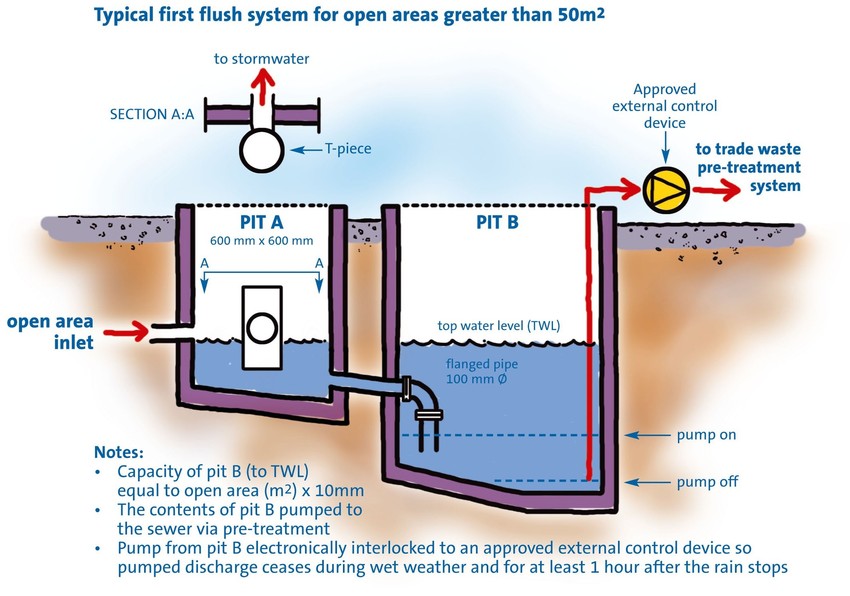
Click to enlarge
Rainfall cut-off device requirements
A tipping bucket rain gauge or similar device must be installed to ensure the wastewater discharge pump can't operate during wet weather. After the first millimetre of rainfall, the device isolates the power supply to the pump for at least one hour after rain stops. Sometimes it may be necessary to isolate power to the pump for longer than one hour. Whenever the rain gauge records 0.5 mm of rainfall, the 60-minute timer resets and the one-hour countdown starts again.
Specifications
- Rain gauge and control with 203 mm catch and 0.5 mm tipping bucket.
- After 2 tips of a 0.5 mm bucket, the controller will:
– isolate the pump power supply
– start a timer selectable for a minimum of one hour
– reset the timer by a minimum of one hour for each successive 0.5 mm of rainfall. - If there's no further rainfall, the power supply to the pump is enabled when the time period expires.
- Power to the controller is provided by a 6 AH battery trickle-charged from a mains supply.
- When you apply for consent to discharge industrial trade wastewater, you will need to verify and supply the rain control logic.
- We require that the installed device can be calibrated. This assures us that the device is in a satisfactory condition and discharges only the prescribed volume.
Excavation and construction
If contaminated groundwater or surface water is collected during excavation and construction, it must not be discharged to our wastewater network. It must be treated and discharged to the site's stormwater drainage system. Talk to the EPA or local council about your requirements.